
High-Precision Benzoic Acid CRM Tablets for Confident Calorimeter Calibration
Calibration Standard for Bomb Calorimeters
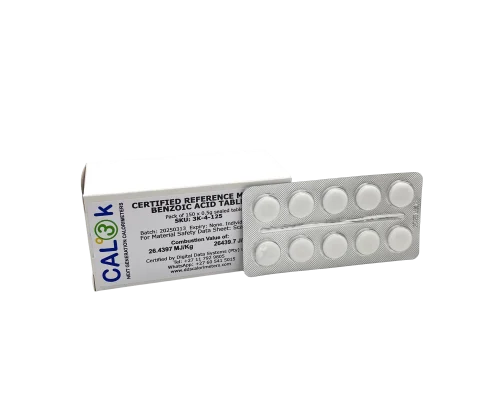
Our certified High-Precision Benzoic Acid CRM Tablets are trusted by the calorimeter industry for over 15 years. Traceable, highly stable, and perfectly portioned to guarantee precision in every combustion test. When it comes to the calibration and continued quality verification of your combustion calorimetric methods, consistency is everything. At DDS Calorimeters, we manufacture premium Certified Reference Material (CRM) Benzoic Acid standard tablets. Our tablets are rigorously tested, metrologically traceable to SI derived units, and manufactured to eliminate the guesswork from your routine fuel testing.
Why Choose DDS Benzoic Acid CRM Tablets?
Our Benzoic Acid tablets adhere to strict standards, from manufacturing to testing. You can expect:
- Uncompromised Precision: Our calorimeter standards are calibrated against NIST Standard Reference Material (SRM) 39j benzoic acid.
- ISO Compliant Manufacturing: Every reference standard is produced in strict accordance with ISO17034.
- Sealed for Freshness: We utilize premium blister packaging to protect individual tablets from environmental factors, ensuring peak condition upon use.
- Exceptional Shelf Life: When kept sealed under normal laboratory conditions, our reference material is stable and remains valid for 20 years from the date of certification.
- High Purity: Our Benzoic Acid contains no Sulphur or Nitrogen, meaning no complex corrections are needed during routine testing.
- Moisture Resistant: The tablets will not absorb moisture from the atmosphere provided the relative humidity does not exceed 90%.
Product Specifications & Ordering Information
Feature | 1g Benzoic Acid Tablets | 0.5g Benzoic Acid Tablets |
|---|---|---|
Part Number | 3K-4-126 | 3K-4-125 |
Dimensions | 14mm diameter x ±5.0mm thick | 14mm diameter x ±2.5mm thick |
Average Mass | 1.0084g per tablet | 0.494883g per tablet |
Identification | “BA” stamped on face | “BA” stamped on face |
Packaging | 10 per blister pack, 8 blisters per box (80 tablets) | 10 per blister pack, 15 blisters per box (150 tablets) |
Price | Affordable price and quantity discount available | Affordable price and quantity discount available |
Product Specifications & Ordering Information
| Feature | 1g Benzoic Acid Tablets | 0.5g Benzoic Acid Tablets |
|---|---|---|
| Part Number | 3K-4-126 | 3K-4-125 |
| Dimensions | 14mm diameter x ±5.0mm thick | 14mm diameter x ±2.5mm thick |
| Average Mass | 1.0084g per tablet | 0.494883g per tablet |
| Identification | “BA” stamped on face | “BA” stamped on face |
| Packaging | 10 per blister pack, 8 blisters per box (80 tablets) | 10 per blister pack, 15 blisters per box (150 tablets) |
| Price | Affordable price and quantity discount available Request a Quote |
Affordable price and quantity discount available Request a Quote |
Product Specifications & Ordering Information
Feature | 1g Benzoic Acid Tablets | 0.5g Benzoic Acid Tablets |
|---|---|---|
Part Number | 3K-4-126 | 3K-4-125 |
Dimensions | 14mm diameter x ±5.0mm thick | 14mm diameter x ±2.5mm thick |
Average Mass | 1.0084g per tablet | 0.494883g per tablet |
Identification | “BA” stamped on face | “BA” stamped on face |
Packaging | 10 per blister pack, 8 blisters per box (80 tablets) | 10 per blister pack, 15 blisters per box (150 tablets) |
Price | Affordable price and quantity discount available | Affordable price and quantity discount available |

Certified Heat of Combustion Values
Our latest batch testing (Batch 20251112) guarantees the following highly accurate combustion values for both our 1g and 0.5g tablets:
- Joules per gram: 26439.7 J/g +/- 27 J/g
- Megajoules per Kilogram: 26.4397 MJ/Kg +/- 0.027 MJ/Kg
- BTU per pound: 25060.00 Btu/lb +/- 26.37 Btu/lb
- Kilocalories per gram: 6319.23 Kcal/g +/- 6.65 Kcal/g
Download Certificates of Analysis
- Download Benzoic Acid Tablets Certification 3K-4-125 (0.5g)
- Download Benzoic Acid Tablets Certification 3K-4-126 (1g)
Calorimeter Calibration Frequency: ISO 1938 & DIN 51900 Standard Compliance
To maintain peak accuracy and comply with strict international methodologies like ISO 1928 and DIN 51900, laboratories must establish a rigorous calibration and verification routine. Utilizing our Benzoic Acid CRM tablets ensures your results remain traceable, reliable, and standard-compliant.
Here is a general guide on when to perform calibrations and run check samples:
1. Full Calorimeter Calibration (Standardization)
A full calibration establishes the effective heat capacity (water equivalent) of your calorimeter system. Depending on your specific methodology, this process typically requires combusting a series of Benzoic Acid tablets (often 5 to 10 burns) to calculate a statistically reliable average. You should perform a full calibration under the following conditions:
- Initial Commissioning: When setting up a new calorimeter system.
- Hardware Replacements: After replacing critical operational components, such as the oxygen bomb/combustion vessel, temperature sensors, stirring mechanisms, or changing the type of ignition wire/cotton thread.
- After Major Maintenance: Following significant servicing or deep cleaning, or physically relocating the instrument to an environment with different ambient conditions.
- Standard Periodic Intervals: Based on laboratory protocols, many facilities perform a baseline recalibration bi-weekly or monthly.
- Control Limit Failures: Whenever routine check samples consistently drift outside of the acceptable tolerance range.
2. Routine Check Samples (Validation)
While a full calibration sets your baseline, routine check samples validate that your calorimeter is holding its calibration. This involves combusting a single Benzoic Acid CRM tablet and comparing the resulting heat of combustion to the certified value on the Certificate of Analysis.
- Daily Verification: Best practice dictates running at least one check sample at the beginning of each day or shift before analysing unknown fuel samples.
- High-Volume Testing Intervals: For busy laboratories, it is highly recommended to run a validation check sample every 10 to 20 tests to ensure continuous accuracy.
- Control Chart Monitoring: The results of your check runs should be documented on a control chart. If a Benzoic Acid check sample deviates from the certified value beyond the defined limits of your standard (e.g., ISO 1928), testing should be halted until a full recalibration is successfully completed.
